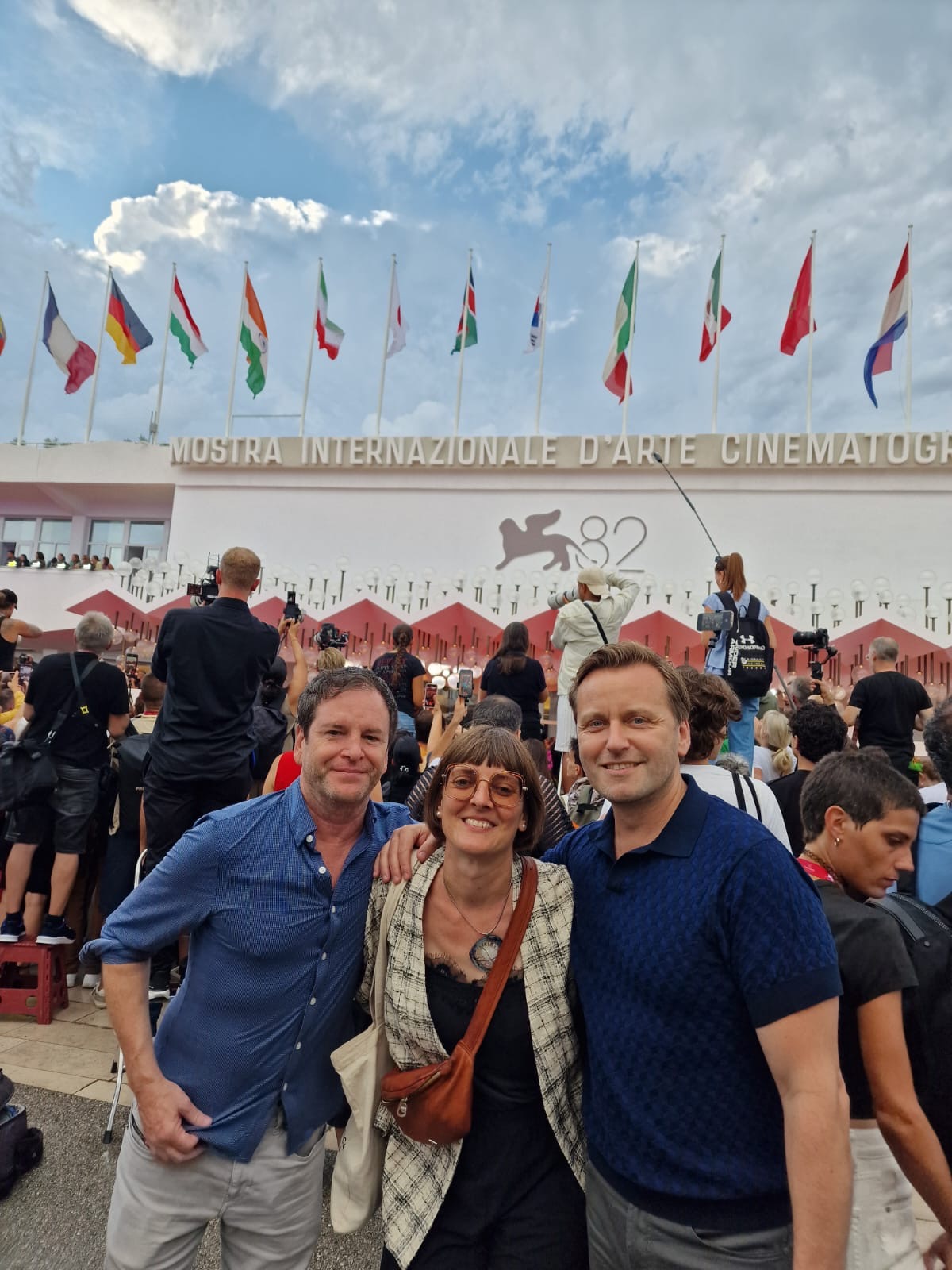
Yesterday’s first film was one of the (as usual, too many) Italian movies in the official selection (just for the record, 5 out of 21 films are Italian productions). With all due respect to my many Italian friends, I do not think that it is representative of Italian cinema’s actual quality (and again, no particular grudge about Italy, I would say the same about France).
Given the fact that we had already seen a jewel in this ocean of Italian movies (Sorrentino’s “La Grazia”), the odds that another jewel would swim out of it were quite low. Low they were, low they remained. They were even smashed to pieces for me after two minutes, when I understood that I would be spending the next two hours with Valeria Bruni Tedeschi. As I am a sadly partial human being, this fact killed all the potential for me to enjoy the projection. I just can’t.
Now, to try and provide you at least with some useful information without dwelling too much on my VBT allergy, “Duse” tells us the story of a renowned Italian theatre diva from the end of the 19th/beginning of 20th century, Eleonora Duse. She seems to be quite a myth in here and used to be called the “divina”. My fellow watchers who do not suffer from the same VBT allergy as me, would tell you that it’s quite watchable (though my VBT allergy made me sleep through part of it as a coping mechanism) and that Bruni Tedeschi is quite a fit for such a diva role (my VBT allergy makes me see hysteria everywhere). So I would leave it to this as, let’s face it, I’m really not the right person to comment on this one.
The second movie, “The Voice of Hind Rajab” had been flagged by Alberto Barbera (the festival’s Director), at the official selection announcement press conference, as extremely powerful. This had triggered my curiosity as Barbera usually barely gives any opinion on the selection, or at least not in such an “engaged” manner. Reading a bit about it ahead of the festival, I understood what could have sparked such an unexpected attitude: the movie uses the real red crescent’s recordings of their calls with a 5 year old little girl who has remained as the only one alive in a car in Northern Gaza. The four other members of her family who were in the car with her are dead. The night is falling (the child is scared of the dark), the Israeli tank that shot at the car is approaching and the little girl is calling for help – desperately begging the rescuers on the phone to come and get her.
The recordings are dreadful and speak for themselves. The screening lead to a 23min standing ovation in the Sala Grande (in the presence of some of its very renowned producers: Joaquin Phoenix and Ronney Mara). Some say it’s the most important movie of the year.
What do I personally make of it? It is actually really hard for me to tell as I am still debating with myself and with my movie buddies. To give you a hint, I will present some of the questions that we are still debating and for which I might not have an answer: aren’t the real life recordings sufficient to speak for this tragedy? Would a documentary format have been better? Does the acting (sometimes overly dramatic) around these real recordings strengthen or weaken the message? Was it the movie that “deserved” the 23min standing ovation or the dreadful context behind it? But isn’t it good if such a movie can at least generate a shock wave, maybe that, as such, justifies for its existence?
As said, I have no answer yet and will leave it for you to see. We can chat about it once it is out and distributed around the globe. I can at least say that the silence that followed the end of the screening (prior to unusually long applauses in the Palabiennale screening hall) confirms the movie’s efficiency. I had to wait for 5mins before I could say a word. The voice of Hind Rajab kept on resonating in my head. It deserved a moment of meditation for all the lost lives in the past years.
 Klara's cinema
Leave a comment